


Power and Oppression
Diminishing communities through fear and hate.
Power and Oppression
Diminishing communities through fear and hate.
People in power have a long history of shaming and demonizing 2SLGBTQI+ people and trying to impose heterosexual and gender norms. This is driven by fear and hate.
For generations, the Government of Canada wrongfully assumed that queer people were dangerous, disloyal and weak. This triggered the LGBT Purge and laws that oppressed sexual and gender minorities. Discriminatory Canadian laws have denied basic freedoms and human rights to hundreds of thousands of people. Both the government’s targeting of queer people and its refusal to support them have made 2SLGBTQI+ communities more vulnerable over time.
Discrimination still happens in ways both big and small. Rights and protections are fragile, and vigilance is essential. We all have a role to play to protect vulnerable communities.

In Canada, homosexuality was partially decriminalized in 1969. Yet, for many decades, police continued to raid queer bars and bathhouses. They beat, harassed and arrested those inside. Over time, authorities also worked to censor queer expression.
–
↑ Photograph of a protester being pushed 1990-002/27P(115), courtesy of The ArQuives:
Canada’s LGBTQ2+ Archives and The Gerald Hannon Estate


From the 1980s, public fear and panic around HIV/AIDS fuelled homophobia and discrimination against gay men. Activists fought against silence and misinformation and against government inaction to help prevent and treat the disease.
–
↑ Photo by René LeBoeuf, courtesy of the Quebec Gay Archives
The National Inquiry into Missing and Murdered Indigenous Women and Girls reveals the high levels of violence faced by Indigenous 2SLGBTQQIA people in Canada. It highlights the urgent work required to meet Indigiqueer people’s needs for culture, identity, health, security and justice.
–
↑ Photo courtesy of Ottawa Citizen, a division of Postmedia Network Inc.
How have you seen the State’s role in discrimination change? What change is still needed?
“It’s always been that the victims of oppression and discrimination carry the heaviest burden and fight the hardest to achieve the change we want to see. People often romanticize Canada in a way that denies our true history. And ending discrimination by policy is only one part of the journey to justice.”
–
Michelle, lesbian activist, quoted in 2017
“As a gay person I was always dreaming to have a life that is not just a taboo life – not a life that I need to hide from everyone.”
–
Zdravko, gay refugee who came to Canada
in 2013

The LGBT Purge
A devastating witch hunt of 2SLGBTQI+ people.
The LGBT Purge
A devastating witch hunt of 2SLGBTQI+ people.
Between the 1950s and mid-1990s, the Government of Canada systematically hunted, harassed and fired 2SLGBTQI+ members of the Canadian Armed Forces, the RCMP and the federal public service.
Now called “the LGBT Purge,” this was one of the largest human rights violations of any workforce in Canadian history. The discriminatory policy was implemented at the highest levels of the government under the false pretense of national security. It was carried out with cruel disregard for the dignity, privacy and humanity of its victims.
The LGBT Purge devastated thousands of lives. It formally ended only after the Government of Canada was taken to court in 1992. Decades later, survivors received some measure of justice in a class action lawsuit won against the government in 2018.
The pain and trauma are still felt today.


Military life often begins at a time when young people are forming their identities. Separation by gender within the military and RCMP allowed same-sex relationships to flourish – romantic and otherwise.
–
↑ Photo courtesy of the City of Vancouver Archives
↗ Photo from Bettmann/Bettmann via Getty Images

Queer people have always been among those who serve Canada. After the LGBT Purge officially ended in the 1990s, many became comfortable being “out” in their jobs. But the culture in the military, RCMP and civil service has changed more slowly than official policy.
–
↑ Photo courtesy of the Department of
National Defence
What is your story of the lgbt purge?
“I was horrified, devastated, my soul was ripped out of me. My whole identity was gone. I had no idea what I was going to do when I got home, because I had to reinvent myself. I was lost. It was the hardest, most difficult time in my life.”
–
Sherry, lesbian survivor, purged in 1981

2SLGBTIQ+ Discrimination in Canada
Eroding basic human rights and dignity.
2SLGBTIQ+ DISCRIMINATION IN CANADA
Eroding basic human rights and dignity.
Everyone in Canada deserves to be their true self, free from discrimination. Yet, since the early years of colonial settlement, 2SLGBTQI+ people have been shamed, excluded, bashed, bullied, regulated, criminalized and even murdered.
The basic human rights and dignity of 2SLGBTQI+ people in Canada have been denied by our governments, our religious organizations, our health care system, our schools, our colleagues, our neighbours and members of our own families. Queer people have been refused employment, health care, housing, social services, marriage, immigration, adoption
and more.
Many still face discrimination in Canada. This diminishes us all.
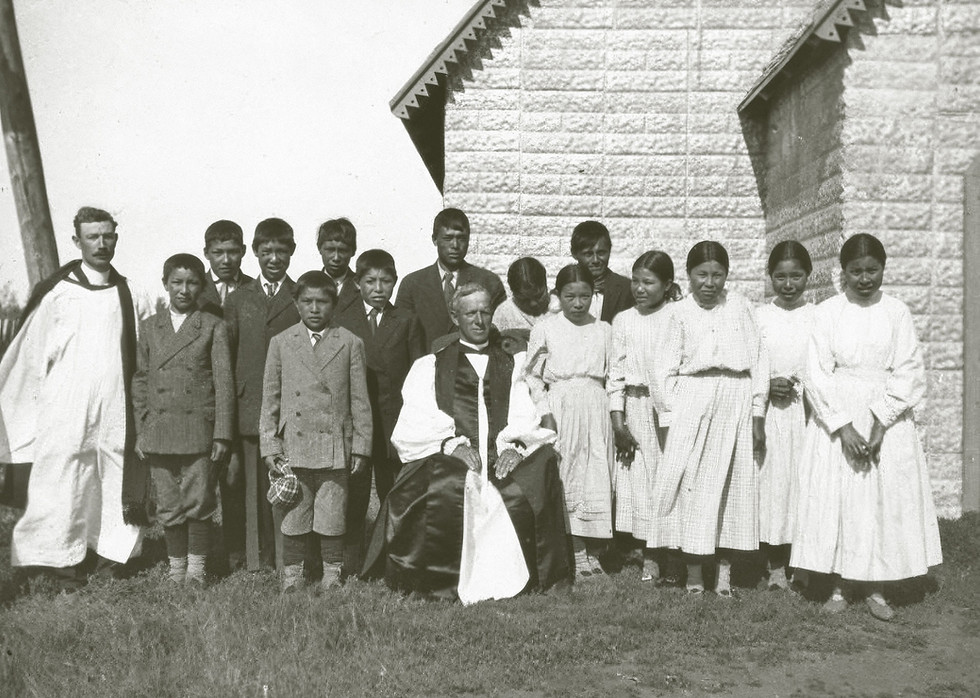
In Canada, homosexuality was partially decriminalized in 1969. Yet, for many decades, police continued to raid queer bars and bathhouses. They beat, harassed and arrested those inside. Over time, authorities also worked to censor queer expression.
–
↑ P7507-3039-26 MSCC - The Rt. Rev James Lucas (centre), A.J. Vale and the Confirmation Class, Hay River, NWT, [ca. 1915]. Photo courtesy of The ArQuives:
Canada’s LGBTQ2+ Archives and The Gerald Hannon Estate

Because of ongoing discrimination, many queer people are still afraid to express themselves. For some, the risks feel too great.
–
↑ Photograph of anonymous protester 1990-002/42P(01), courtesy of The ArQuives: Canada’s LGBTQ2+ Archives and The Gerald Hannon Estate
In what ways do you see discrimination persist?
“Canadian homosexuals are having their careers ruined, being kicked out of their churches, having their children taken away from them and being assaulted in the streets of our own city. What have we done to deserve this? Love, that’s all we’ve done. All we want to do is love people of the same sex and live our lives as we decide for ourselves.”
–
Community demands read at a 1971 protest
“We’re seeing a revival of the anti-gay hysteria from the 1970s. I worry, every time I do an event, that something horrible could happen. There is a risk that hate will shift from a virtual context to a horrifying and terrifying in-person experience. I have never been as worried as I am right now about the future of trans rights and acceptance in
this country.”
–
Fae, trans woman and 2SLGBTQIA+ advocate, interviewed in 2023
“We don’t want extra rights or to take anyone else’s rights away — we want equal rights. Our human rights are constantly being threatened by political whims. We need to be ever vigilant so that the rights we have are not taken away. They are fundamental to a vibrant democracy.”
–
Mary-Woo, lesbian and human rights defender, quoted in 2023
“I was a small-town kid who didn’t even really know any other queer people. I don’t think I had even whispered the word ‘trans’ yet into the mirror. I knew nothing of my history. I had no role models, or examples, or proof of a future for myself. I wish so much I wasn’t still afraid of who I was when I first told my mom about myself, and I wish she had told me that she was way more afraid of what the world was going to do to her queer kid than she was that her kid was a queer. Mistaking that fear for her shame cost us years and years of wasted tears.”
–
Ivan, non-binary trans storyteller, quoted
in 2021
“In the way that gay fathers do not have protection from discrimination based on the indoctrination of their children into Christianity. Marriages dissolve for various reasons, but when someone's marriage dissolves because the husband decides to come out, and the Mother turns their kids to religion and teaches them to hate their parent because being gay is a sin, there is no protection against this form of discrimination... We still have avenues of hate that attack us every day.”
–
Béla Gyarmati
“I was bullied from grade one all the way through high school for being gay. I didn't even know what it was in elementary school. I had teachers laugh when they saw me being called a homo by other kids. As an adult, I've been gay bashed in the streets while people walked right past. I've had hate mail left on my door step. I'm 64 now, and people still hurl the word faggot at me. We are now protected under the Canadian Charter of Rights and Freedoms. Our future generations need to know that it's OK to be who you are, and it's not ok to be punished for who you are.”
–
Cole Barry

The Human Toll
The impacts of discrimination are deep and enduring.
The Human Toll
The impacts of discrimination are deep and enduring.
Discrimination has led to painful and enduring experiences for queer people. These include depression, substance abuse, rejection, suicide, homelessness, poverty, isolation, erasure and the devastation of HIV/AIDS.
Countless lives have been lost and damaged. And the social, physical and emotional impacts have been felt through generations.

Trans people have become the target for hate and violence in Canada and around the world. This has led to high rates of suicide, poverty and depression among trans people of all ages, including kids.
–
↑ Photo by Derek R. Henkle/AFP via Getty Images
How has discrimination had an impact on you?
“I plunged so deep into depression that I could no longer see the light. The victims of conversion therapy were not just me. My whole family has suffered. Family ties were challenged, trust was broken and we no longer understood each other. For them, I had given my soul away to the devil. For me, they did not value my life.”
–
Stéphane, queer man and conversion therapy survivor, date unknown
“My father, pressured by several medical experts, ‘consented’ to a surgery that promised to make me sexually normal. What it actually did was change a perfectly healthy seven-year-old girl into a woman who feared her own body and her past and who hated herself for being different. The cure imposed by the HSC in Toronto taught me how to hate and fear myself. It was the hate and fear that is heterosexism and homophobia. Only much later, I realized that, as an intersex person, I had never been a monster.”
–
Morgan, intersex activist and key founder of critical intersex studies, quoted in 1996
“My partner went to his doctor looking for help with depression, but ended up at an institute that was working with the CIA and RCMP. They were doing brain experiments. He was given 36 shock treatments. He also had huge amounts of Seconal prescribed, among other things. He essentially had his brain scrubbed. It was to stop him from being queer. He had all his memories taken away, but, guess what, after all that, he was still queer.”
–
Ken, husband of David, survivor purged in 1961
“We don’t need your harmful words hitting our community, not again, not with how far we’ve gotten. We have existed for thousands of years. We shall not be erased.”
–
Émile, non-binary teacher and queer youth advocate, sharing words from students in 2023
“I was left for dead in a snowbank after being severely beaten by three strangers. This monument reminds me their hatred is not for me, but for themselves. ”
–
Aaron Grant Norton

Queer Activism in Canada
Galvanizing a movement for our communities.
Queer Activism in Canada
Galvanizing a movement for our communities.
Queer people have long resisted homophobic and transphobic laws, violence and oppression. Individual defiance became a movement after the Second World War. During this time, queer and trans subcultures were blossoming. The Canadian government, church and media reacted in fear by vilifying 2SLGBTQI+ people. They incited moral panic about gender roles and expectations.
Even joyful acts – like drag performances, raising kids and consensual adult sex – have led to queer people being beaten, jailed, shamed and murdered.
From coast to coast to coast, queers found each other. They asserted their rights through Indigenous marches and gatherings, gay-straight alliances, parents’ groups and cultural and ethno-racial associations. Connections were also made through community bookstores, archives, sports and leisure groups, HIV/AIDS organizations, health care and peer support groups, queer-affirming religious spaces, Pride festivals and more.
Queer activists have worked to educate, reduce stigma, change laws and increase social acceptance.

In 1971, “We Demand” was the first major queer rights demonstration in Canada. It took place simultaneously in Ottawa and Vancouver. People from across the country gathered on Parliament Hill to demand equal human rights. They insisted on equal access to housing, health care, employment, legal status and immigration. They also demanded an end to the LGBT Purge.
–
↑ Photo by Jearld Frederick Moldenhauer


Sometimes together, sometimes fractured, queer activism has been connected to other movements and supported people with shared experiences of discrimination and violence. These include Indigenous groups, labour unions, feminists, sex workers, Black and racialized people and newcomers.
–
↑ Photo courtesy of AGIR Montréal Faces are blurred to protect the identity of those pictured.
Queers have made space for activism, fought through the courts and held demonstrations. But activism takes many forms. Political art, poetry, film, theatre, music, dance, performance and drag have provided powerful outlets for queer visibility and expression. Queer communities have also shared their message through radio shows, zines, newsletters and periodicals, conferences and academic talks.
Which key moments define this movement for you?
“It felt like every weekend there was a demo, because not only were there conversations happening around queerness, there were conversations happening around race, there were conversations happening around gender, particularly for women. The women’s movement was happening. Every weekend it was like: Where are we going to meet up? This was without social media and cellphones. We would find each other and be on the front lines making noise and there was a real sense we could change the world.”
–
Douglas, gay activist, speaking about the 1980s
“I was offered a job and my boyfriend immigrated with me to Canada from the US. His permit to enter was recognized with mine despite limited access to legal recognition in our home country. I will always be grateful for the respect Canada showed to our relationship. We became citizens in 2017 at the same ceremony.”
–
Jeffrey Busby, Vancouver, BC
“I was in my mid 20s, coming out to myself as a young officer in the Canadian Air Force. After my dad died and I was transferred to a rural base away from my boyfriend and friends, I melted down emotionally. Despite the fact that the Canadian military had only recently “allowed” homosexuality, my new CO supported me whole-heartedly and made sure I got the help I needed. This kindness and support played a role in shaping my future career as an educator leader focused on SOGI inclusive education in the K-12 system.”
–
Steve Mulligan
“I came out in 1969. Then moved to Toronto in 1971 where Holly Devor, now Aaron Devor and I decided to start a lesbian feminist newspaper which became "The Other Woman"in 1972 and started a lesbian drop in at the Dupont Street Women's Center the next year. We worked with other woment to organized the first Gay Women's Conference at 21 McGill St YWCA where women came wearing bags over their heads in 1973. Co founded Wages Due Lesbian and CORA The Women's LIberation Bookmobile with a gay selection of materials that we took around Ontario. When I moved back to Vancouver in 1981 I was part of organizing a lesbian conference and an art show at Langara College...
...I worked with Richard Saunders to organize the Vancouver contingent to the first San Francisco Gay Games where Tina Turner sang and my soccer team came in second. In 2002 I was elected the first out lesbian in Canada. Tim Stevenson who was on Council and I organized the first LGTBQ Council Advisory Committee and a contingent of the entire City of Vancouver in the Gay Pride March launching it a City Hall. I have travelled all over the world speaking out on Queer rights at conferences all over Canada and around the world, from New York to Turkey, Uruguay, Prague, Bolivia, Kuala Lumpur, Abhu Dhabi (where it was punishable by death), Quito, Berlin, Ankorah, Tokyo etc. Now I am in a queer riting collective Quirk-e which publishes books and Zines yearly. I am also the Co President of WILPF Canadal, a member of DIGNITY NETWORK. "
_
Ellen Woodsworth

Community Resistance and Change
Activists and allies make a difference through brave action.
Community Resistance and Change
Activists and allies make a difference through brave action.
Laws that criminalize and exclude 2SLGBTQI+ people in Canada have changed. These changes are due to ongoing community activism and court challenges, not because of the government’s goodwill. Social attitudes toward queer people and understandings of human sexuality have also evolved over time.
It has taken extraordinary resistance, relentless pressure and collective action to make a difference. Activists and allies have come from all backgrounds. They have included progressive leaders in politics, labour movements, law, religious groups, health care and more. Without brave people fighting for themselves and others, there would be no change and no monument here today.
While there is much to celebrate, queer activists continue to fight to protect what has been achieved and to secure a safer, more just future.

Queer rights are human rights. To achieve this recognition, many battles for justice and equality have been fought in the courts. Since 1985, courageous litigants and determined lawyers have used the Charter of Rights and Freedoms to protect 2SLGBTQI+ communities. The courts are also where the LGBT Purge policy was formally ended and where Purge survivors won their class action lawsuit against the Government of Canada.
–
↑ Photo by Mitchel Raphael

Since the 1970s, Pride festivals and events have made space to protest inequality, make queerness visible and celebrate gains. Work continues to make Pride more inclusive for trans people, Black, Indigenous, disabled and racialized queer people and many more. Many different versions of the Pride flag have been created to reflect this inclusion.
–
↑ Photo by Laura Proctor
What are your stories of community resistance?
“I began one sentence casually with the words ‘As a homosexual myself…’ There was an almost audible gasp from the audience… It must be remembered that at that time homosexuality was still a fairly novel topic, and it is extremely unlikely that anyone in the audience had ever heard a public declaration of homosexuality. It was an extraordinary feeling. I had broken cover and was standing in the brightly lit open. There was fear, but it was overwhelmed by a surge of euphoria. No more hiding, no more lies, no more deception; there was no going back now.”
–
Peter, gay man, reflecting on a 1974 debate
“You only get one life, don’t waste it trying to change who you are. People who dislike you for things you cannot change are wrong. There are people out there who love you. You aren’t alone. Remember there’s a light at the end of the tunnel, no matter how dark travelling through it is.”
–
Alex, genderfluid bisexual activist, quoted
in 2021
“If you have a transgender kid you are living with a unicorn, an amazing human being. To be next to someone so brave, so cool, so close to themselves. The reality is, it’s such an honour.”
–
Cis-gender father of a transgender kid, quoted in 2015
“I couldn’t believe what the judge was saying. We’d won! We’d done it. We’d achieved this amazing feat together – we finally got our justice from the government. It was at that moment, and also at the government’s apology in 2017, when we finally felt seen. We finally felt heard. We were Purge survivors, and together we were strong.”
–
Martine, lesbian Purge survivor and class action claimant, quoted in 2018

Indigiqueer Experience and Colonialism
Rising against imported homophobia.
Indigiqueer Experience and Colonialism
Rising against imported homophobia.
Across North America, there was once greater freedom to express gender and sexual diversity. Before colonization, gender identity and expression were more fluid, and LGBTQI+ First Nations, Inuit and Métis people had important functions in their communities.
Homophobia, transphobia and misogyny came to these lands with white settlers. Colonial institutions and Christianity worked to suppress and erase Indigenous sexuality, gender norms and spirituality. These efforts negatively transformed how Two-Spirit and Indigiqueer people were seen and treated. This, in turn, often changed how Indigiqueer people saw themselves, resulting in shame, isolation and restrained self-expression.
Today, ongoing anti-Indigenous racism adds to the discrimination faced by Indigiqueer people in Canada. Through healing and education, people who identify as Indigiqueer and/or Two-Spirit have been working to restore their place of respect within their communities. Reconciliation is still needed, with both people outside 2SLGBTQI+ communities and those within them.

The term “Two-Spirit” is used by Indigenous people across nations to describe a wide range of Indigenous genders and sexualities. It was proposed at the 3rd North American Native Gay & Lesbian Gathering near Beausejour, Manitoba, in 1990. Though widely adopted, it is not embraced by all LGBTQI+ First Nations, Inuit and Métis people. Many are also reclaiming terms from traditional languages to describe themselves.
–
↑ Photo courtesy of the University of Winnipeg Archives, Albert McLeod fonds (11.11, 5-1, 14)


Colonial actions spread homophobia both outside of Indigenous communities and within them. As a result, Two-Spirit and Indigiqueer people have been rejected from their traditional circles, ceremonies and communities. Knowledge Keepers teach that everyone has a divine gift to contribute and should have a place. Reclaiming Indigiqueer identities awakens Indigenous communities to diversity and spirituality. And adding “2S” to the ever-evolving queer acronym brings spirituality and reconnection to the land to the queer movement.
–
↑ Photo by Sadie Phoenix Lavoie
← Red Ookpik by Kablusiak (2022), photo courtesy of the artist + Norberg Hall
↙ Feathercase and beadwork by Benny Michaud, Métis Nation
What’s your Indigiqueer
story of these lands?
“My grandmother said, you have two spirits in your body, mind, soul and your heart. She says, you’re going to have a hard life, a real tough life because of who you are. Seven generations from the time she was a little girl, she had been told that there were Two-Spirit people that lived among First Nations people and nobody ever made fun of them. They were regarded as special people. Now we are told we are savages, and we are nobody except if we join the other people.”
–
Ma-Nee, Two-Spirit Ojibwa-Cree Elder, quoted in 2017
“The first thing they did was divide us by
boy/girl. Girl go this way, boy go this way. Girl wear pinafores. Boy wear pants. All hair cut… I didn’t really know which side to go to. I just knew that I wanted to be with my sisters and my brother. I had never worn a dress before so I went with my brother… It was like a little factory — one priest shaved my head while the other tore off my clothes. I was so scared. I covered my area. It didn’t take long for them to notice… That was my first beating.”
—
“S,” lesbian residential school survivor,
date unknown
“Watching James Makokis & Anthony Johnson win Canada's Amazing Race made my heart soar for all the young Two-Spirits and Indigiqueer young people across Turtle Island. I only wish I had this beautiful Two-Spirit representation in the 90s in my life at a time when I needed it most.”
—
Kara Louttit

Diverse Communities, Diverse Experience
Fighting together for those still on the margins.
Diverse Communities, Diverse Experience
Fighting together for those still on the margins.
Queer communities are many and diverse. Experiences of exclusion and resistance are just as varied.
Some queer people are further excluded when they hold other identities, such as being racialized, Indigenous, a person with disabilities, a newcomer, a refugee or a woman. This means they are excluded not only from 2SLGBTQI+ communities, but also from other communities they belong to. Certain groups within queer communities — including transgender, non-binary and intersex people — also face more exclusion and violence than others.
Historically, major gains in queer rights have reflected the interests of queer communities that hold more power. There is still work to do to recognize how individual identities and circumstances impact exclusion and to champion the issues faced by those who are most marginalized in our communities. We can’t rest until everyone is safe and equal.

Love and desire are facts of human nature. Queerness traverses race, ethnicity, age, gender, religion, class, economic status, ability and background. Visibility and representation are important for all 2SLGBTQI+ people — inside and outside queer communities.
–
↑ Photo by Diego Moura
How has your identity and/or privilege shaped how you’ve been excluded or included?
“There’s a lot that needs to change, but in addition to pulling down walls, we also have to be planting the seeds. Through hope and through community and through practice and activism, we can start to craft the kind of world that we want to live in. We need everybody to get involved. Not as a favour, but because our liberation is tied up with each other’s. We’re going to have the most beautiful world and we’re going to do it together.”
—
Syrus, queer activist and visual artist, quoted in 2024
“We’re queer, we’re here and we’ve always been here. We’ve always been here regardless of our skin colour, regardless of our religions, regardless of our communities or anything else.”
—
El-Farouk, queer human rights activist, lawyer and imam, quoted in 2020
